Send the exact assignment or rubric from your classroom and a custom sample written to it lands in 24 to 48 hours, the first one free. N490 is Aspen’s Issues and Trends in Professional Nursing course. It centers on reading a current pressure on the profession closely enough to argue about it with sourced evidence rather than opinion. Searches like "n 490 module 4 assignment example", "N490 sample paper", and "N490 module samples" land on this page.
What N490 is really about
N490 sits early in Aspen's RN-to-BSN sequence, and most people meet it while still working full shifts. The course runs across eight modules on a monthly start, so the reading and the writing arrive in a steady rhythm rather than one long stretch. Content usually circles the pressures shaping practice now: staffing and workload, scope and delegation, licensure and regulation, the role of professional organizations, workplace safety, and the way technology keeps changing what a shift looks like. Discussions carry a share of the points in most classrooms, and the written assignments ask you to pick one pressure and stay with it.
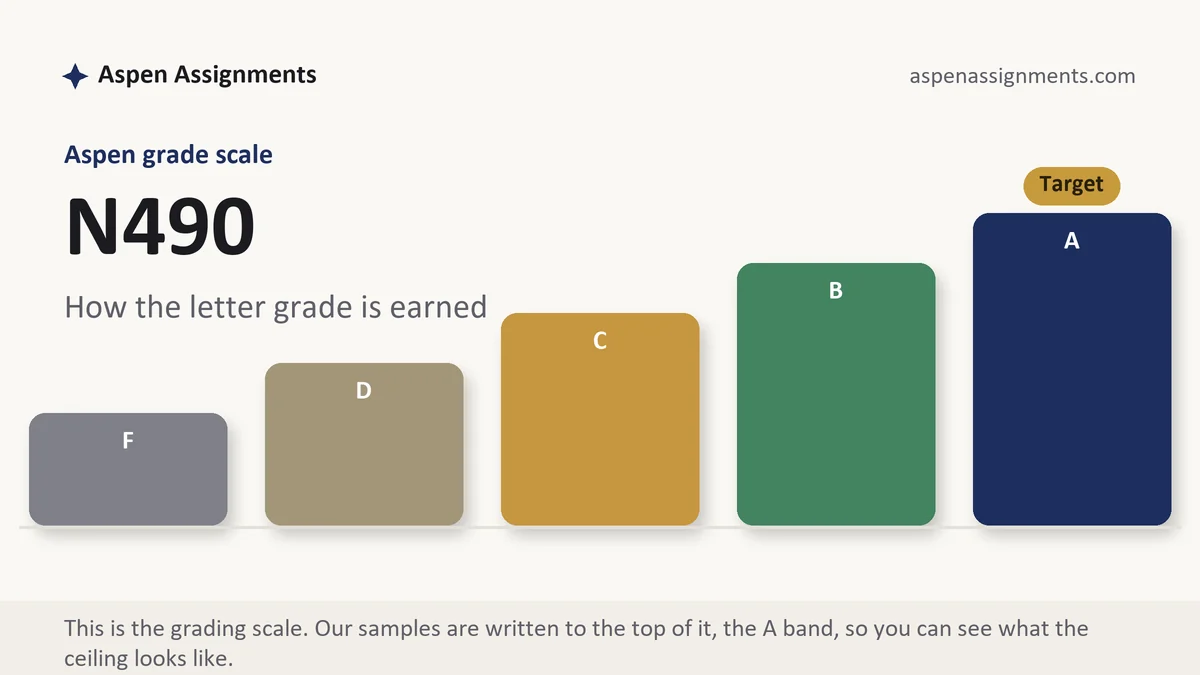
The writing itself is argumentative rather than descriptive. In many sections the early modules ask for a defined issue and a working position, the middle modules build the evidence base and bring in the people who disagree with you, and the later modules pull everything into one longer paper. Grading runs through a rubric, points land against named criteria, and those points become the letter grade at the end of the term. Instructors here tend to read for one thing above all: whether the claim you made in paragraph two is still standing, and still sourced, by the last page.
What N490’s assessments ask for
What the course wants is an argument a reader can check. That means naming the issue narrowly enough to say something about it, showing that the trend is real before saying what it costs, and identifying who is affected and who decides. Expect to work with position statements from nursing organizations, regulatory language, workforce data, and peer-reviewed studies, and to say plainly which is which. Expect to write for a professional audience rather than a classroom one, so the tone stays measured even when the subject is not. And expect the rubric to ask for a recommendation at the close, one that follows from the evidence you presented rather than from how strongly you feel.
Where students lose points in N490
Points leave this course through editorial writing. A paper says nurses are leaving the bedside in record numbers, that ratios have never been worse, that morale is at an all-time low, and none of those three sentences carries a source. Every RN reading it nods, which is exactly why the gap is easy to miss. The rubric is not asking whether the claim holds in your hospital; it is asking whether you can show the trend outside your hospital, with a number, a date, and a name attached. Strip the sourced middle out of an issues paper and what remains is a well-written opinion piece, which grades as one.
The N490 drawers
N490 Module 1 assignment example
Evolution of nursing paper: the reformers and reports that built the profession. Full sample paper, read it free.
N490 Module 2 assignment example
Stress and burnout paper: causes, evidence and an organizational plan for one unit. Full sample paper, read it free.
N490 Module 3 assignment example
Technology and telehealth paper: what the heart failure monitoring trials mean for a nurse-led program. Full sample paper, read it free.
N490 Module 4 assignment example
Mental health in the community paper: the physical health gap for people on antipsychotics. Full sample paper, read it free.
N490 Module 5 assignment example
Cannabis and nursing paper: assessing cannabis use in older adults safely and without judgment. Full sample paper, read it free.
N490 Module 6 assignment example
Cultural competence paper: language access and professional interpreters as a nursing responsibility. Full sample paper, read it free.
N490 Module 7 assignment example
Healthcare and violence paper: client violence against home health nurses who work alone. Full sample paper, read it free.
N490 Module 8 assignment example
Future of nursing reflection: the next decade of the profession and the writer's place in it. Full sample paper, read it free.
Your classroom shows something else?
Aspen University revises courses; module counts and deliverables shift between terms. Send what your classroom shows and the desk matches it exactly.
Using a N490 sample the right way
Read a sample the way you would read a colleague's draft: watch where the claim is stated, where the source arrives, and how far apart those two sit. Then write your own. If you want one built around the issue you actually chose, send the assignment instructions and the rubric from your classroom and the first custom sample is free, back in 24-48h. It is a model to write against, not a paper to submit, and it does the most good when it arrives before you draft rather than after.
How these samples are written
Method, in one line: rubric first, structure from the rubric, phases staged, format exact. Module counts vary by course; the catch-all row absorbs the difference. Your free request matches what your classroom actually shows.
N490 questions, answered
How do I show a trend is real instead of just asserting it?
Attach the claim to something a reader can look up. A position statement, a state board report, workforce survey data, or a study with a year on it does the work that 'everyone knows' cannot. Say what the source measured and over what period, then say what that means for practice. Samples show the pattern in place.
My reference list is mostly summaries and roundups. Is that a problem?
It usually is. A news roundup or a textbook paragraph describing a study is a report of the evidence, not the evidence, and reference lists built entirely from those read as thin. Track down the report or article being summarized, cite that, and keep the summary only where it adds context of its own.
Two sources disagree about the same trend. Which one do I use?
Use both, and say why they differ. Sample size, year, region, and who paid for the work all change what a number means, and a paper that names the difference reads stronger than one that quietly picks the friendlier figure. Rubrics tend to reward that handling rather than penalize the complication.