Send the exact assignment or rubric from your classroom and a custom sample written to it lands in 24 to 48 hours, the first one free. N491 is Aspen’s Concepts and Theories in Nursing course. It centers on taking a nursing theory off the page and running it against a real situation until it explains something. Searches like "n 491 module 4 assignment example", "N491 sample paper", and "N491 module samples" land on this page.
What N491 is really about
N491 usually lands right after the issues course, and it asks for a different kind of thinking. Eight modules, a monthly start, and a reading list that moves from the metaparadigm through grand theories, middle-range theories, and the borrowed models nursing takes from other fields. Most RNs arrive already using theory without the vocabulary for it: the way you frame a patient's capacity for self-care, the way you decide what counts as a comfort measure. The course puts names on that. Watson, Orem, Roy, Benner, Peplau, Leininger and others show up in the reading, though which ones anchor a given section varies with the instructor.
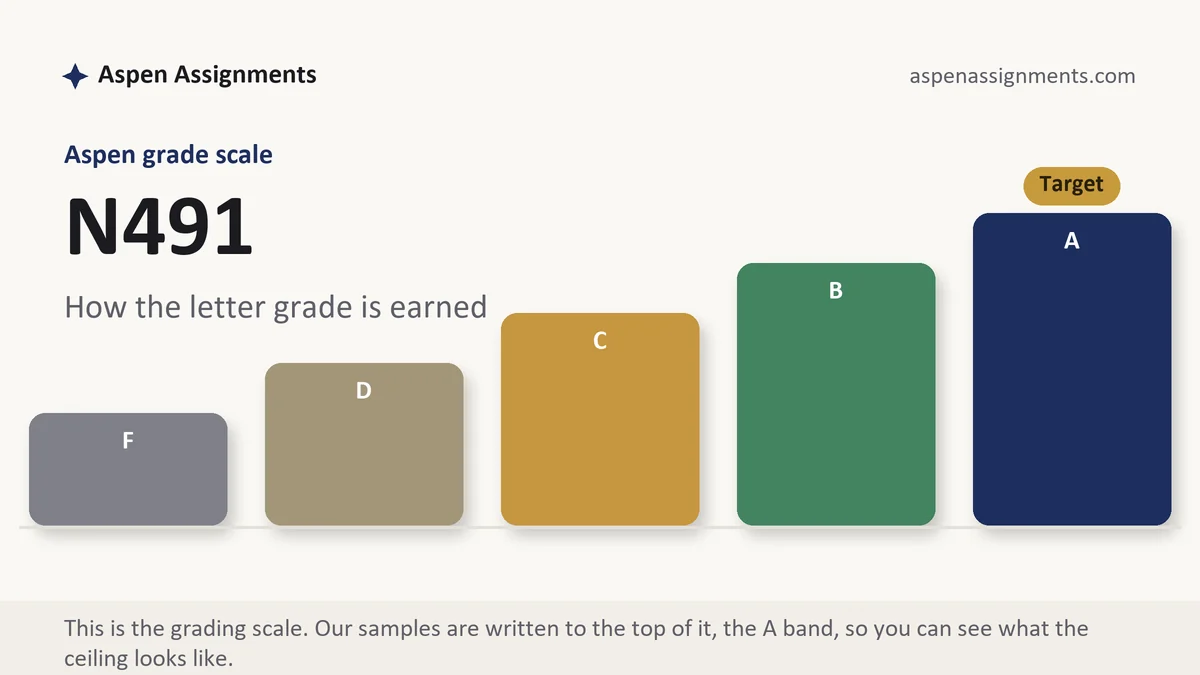
The written work moves from description to use. In many classrooms the first assignments ask you to explain a theory in your own words and place it against the metaparadigm, a concept analysis follows somewhere in the middle, and a longer application paper closes things out. Discussions run alongside and often ask you to defend one theorist's reading of a situation against another's. Points sit against rubric criteria and add up to the letter grade. The criterion that decides most grades is not comprehension of the model. It is whether the model did any work once you brought it to a case.
What N491’s assessments ask for
Application is the whole ask. Pick a situation you have actually stood in, then let the model organize it: what the theory says a person needs, what it says the nurse contributes, what it counts as a good outcome. A strong paper shows the theory changing the reading of the case, so a reader can see what would have been missed without it. Expect to define the concept you are analyzing through attributes, antecedents, and consequences rather than a dictionary line. Expect to cite the theorist directly at least once. And expect the rubric to ask, somewhere, whether the model you chose was the right one for this case rather than the one you liked.
Where students lose points in N491
The grade usually slips in the same place. A paper opens with the theorist's biography, walks through the propositions of the model, credits its contribution to the discipline, and reaches the last page without a patient in it. Nothing in it is wrong. Nothing in it is applied either, and application is what the rubric scores. The tell is that the whole paper could be rewritten about a different theorist by swapping the name and the propositions. If your case can be lifted out and the writing still stands, the theory was decoration. Bring one situation, run the model through it step by step, and let the summary shrink to the paragraph it needs to be.
The N491 drawers
N491 Module 1 assignment example
Nightingale's environmental theory applied to a case: five components, a prioritized care plan, practice application. Full sample paper, read it free.
N491 Module 2 assignment example
Two-part PowerPoint: Peplau's nurse-patient relationship phases and Orem's self-care deficit theory, each with a practice example. Full sample paper, read it free.
N491 Module 3 assignment example
PowerPoint: Orlando's deliberative nursing process applied to a case, family care plans, and the 1950s-1960s context that shaped nursing theory. Full sample paper, read it free.
N491 Module 4 assignment example
King's conceptual system paper: three systems with examples, goal attainment, a quality problem and a practice improvement. Full sample paper, read it free.
N491 Module 5 assignment example
PowerPoint: Roy's adaptation model and the Neuman systems model applied to a service member after limb loss. Full sample paper, read it free.
N491 Module 6 assignment example
Two case studies: Leininger's culture care theory in a discharge plan and Watson's caring theory at the bedside, with strengths and limits of each. Full sample paper, read it free.
N491 Module 7 assignment example
Parse's human becoming theory at the end of life: a home hospice case, the nurse's presence, barriers, transcendence and a second theory. Full sample paper, read it free.
N491 Module 8 assignment example
Course review PowerPoint: one theory from each module with applications, patient outcomes, nurse satisfaction, barriers and solutions. Full sample paper, read it free.
Your classroom shows something else?
Aspen University revises courses; module counts and deliverables shift between terms. Send what your classroom shows and the desk matches it exactly.
Using a N491 sample the right way
Use a sample to find the pivot: the sentence where description stops and the case takes over. That move is what most drafts are missing, and copying the structure is far easier than inventing it under a deadline. Read a concept analysis sample the same way, watching how each attribute earns its place. For a sample built on the theory and the situation you are working with, send your assignment instructions and rubric and the first one is free, back in 24-48h. Written to your classroom's requirements, meant to be read beside your draft rather than turned in.
How these samples are written
Every sample in this log is written the way the custom ones are: the rubric decoded row by row, graduate courses held to the no-D graduate ladder's reality, formats exact. Aspen revises classrooms; a custom request is always written to the rubric in YOUR course, never from a stale template.
N491 questions, answered
How much of the paper should describe the theory?
Enough that a reader who does not know the model can follow the analysis, and no more. A tight paragraph on its assumptions and key concepts usually carries it. Everything after that belongs to the case, with the model doing visible work on it. Samples show where that line tends to fall.
Can I cite a textbook chapter about the theorist instead of the theorist?
You can cite it, but not only it. A chapter summarizing Orem is one author's reading of Orem, and a reference list assembled entirely from summaries reads as second hand. Pull the theorist's own text for the definitions you lean on, then use the chapter for context or critique. That mix holds up.
The theory I picked does not fit my case very well. Now what?
Say so, in the paper. A short section on where the model explains the situation and where it falls short is stronger analysis than forcing the fit, and rubrics generally treat that as evaluation rather than error. If the mismatch runs all the way through, changing the case is faster than changing the theory.