Send the exact assignment or rubric from your classroom and a custom sample written to it lands in 24 to 48 hours, the first one free. N495 is Aspen’s Health Assessment course. It centers on the head-to-toe examination and, just as heavily, the write-up that turns what you found into what it means. Searches like "n 495 module 4 assignment example", "N495 sample paper", and "N495 module samples" land on this page.
What N495 is really about
N495 is the course where a skill you already have gets rebuilt on paper. Eight modules on a monthly start move through the body in sequence: the health history and general survey first, then skin, the head and neck, eyes and ears, respiratory and cardiovascular, abdomen, musculoskeletal and neurological, with lifespan and cultural considerations threaded through. Most RNs in this course assess patients every shift and document in flowsheets and checkboxes. The classroom wants narrative instead, in full sentences, organized by system, with subjective and objective data kept apart. That switch is what makes an experienced nurse feel slow in the first modules.
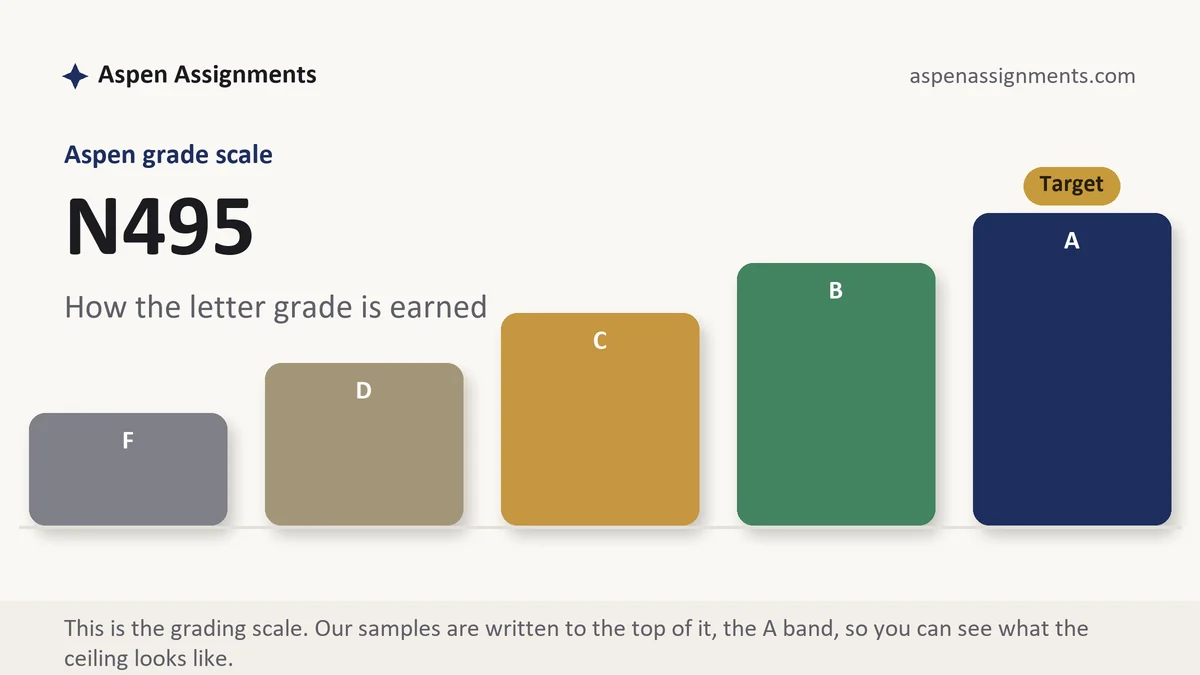
Assignments in many sections pair practice with documentation: you perform an examination, then write it up the way another clinician would need to read it. Discussions often work through technique, normal variants, and what an unexpected finding should prompt. Points come off a rubric and become the letter grade. One line stays clear on this shelf. The examination you perform on a real person, any recording or demonstration a section requires, and any verification of that encounter are your own record, and nothing here reconstructs them. Samples cover the written layer: structure, sequence, phrasing, and the reasoning that has to show up in it.
What N495’s assessments ask for
The write-up is judged as clinical communication. Subjective data goes where subjective data belongs, quoted from the patient where the wording matters, and objective data stays observable: what you saw, heard, felt, and measured, in the terms another nurse would use. Expect a complete health history with a review of systems that does not quietly turn into the physical examination. Expect precision in description, so a lesion carries size, shape, color, border, and location rather than the word small. Expect normal findings documented rather than skipped, because absence is information. And expect a closing section that says what the findings suggest, what you would teach this patient, and what you would follow up first.
Where students lose points in N495
The write-up that loses points is the one that stops at the record. Ten pages of accurate observation, every system covered, nothing wrong anywhere in it, and not one sentence saying what any of it means. A patient reports shortness of breath climbing stairs, the paper notes crackles at the bases and mild ankle swelling, and then moves on to the abdomen without connecting the three. That connection is the assignment. Rubrics ask for findings analyzed against expected norms and for a plan that follows from them, which means naming what a finding suggests, saying what it argues against, and being specific about what you would assess next and why.
The N495 drawers
N495 Module 1 assignment example
Aging adult case study: BMI, nutrition and mobility screening tools, outcomes, interventions and referrals for a 71-year-old. Full sample paper, read it free.
N495 Module 2 assignment example
One-page infographic on RSV vaccination for older adults, with a 750-word APA essay on the evidence and the nurse's role. Full sample paper, read it free.
N495 Module 3 assignment example
PowerPoint for assisted living staff: supporting ego integrity through group and individual activities. Full sample paper, read it free.
N495 Module 4 assignment example
Respiratory and cardiovascular systems usually sit mid-course, so samples cluster related findings rather than listing them. On request, free, 24-48h.
N495 Module 5 assignment example
Stress and nursing practice paper: a formative case, why debriefing matters and how to build it into a unit. Full sample paper, read it free.
N495 Module 6 assignment example
Written documentation for the head-to-toe assessment video: a healthy adult volunteer, system by system, with technique notes. Full sample paper, read it free.
N495 Module 7 assignment example
PowerPoint: building a personal hurricane emergency plan and supply kit with an 82-year-old who lives alone. Full sample paper, read it free.
N495 Module 8 assignment example
Signature holistic assessment: history, six dimensions, pathophysiology and a teaching plan for a woman newly diagnosed with rheumatoid arthritis. Full sample paper, read it free.
Your classroom shows something else?
Aspen University revises courses; module counts and deliverables shift between terms. Send what your classroom shows and the desk matches it exactly.
Using a N495 sample the right way
Read a sample for its reasoning sentences first, the ones that arrive after a finding and start doing something with it. Those are the sentences most drafts leave out, and seeing where they sit inside a full document is faster than reverse-engineering them from a rubric line. When you want one matched to your own assignment, send the instructions and rubric from your classroom and the first custom sample is free, back in 24-48h. It is written to your section's requirements as a model for your documentation, not as something to hand in.
How these samples are written
Method, in one line: rubric first, structure from the rubric, phases staged, format exact. Module counts vary by course; the catch-all row absorbs the difference. Your free request matches what your classroom actually shows.
N495 questions, answered
What does interpreting a finding actually look like on the page?
One or two sentences after the observation. Name the finding, place it against what is expected for this patient's age and history, say what it suggests and what it makes less likely, then name your next step. That is the difference between a record another clinician has to think about and one they can act on.
Everything I found was within normal limits. What is left to interpret?
Plenty. A normal finding rules things out, and saying which things is interpretation. If the history raised a concern and the examination did not support it, write that sentence rather than leaving the reader to infer it. A clean examination documented with reasoning still shows the clinical thinking a rubric looks for.
Where should the sources in a health assessment write-up come from?
From the assessment text your section uses and from clinical guidelines, cited directly. Study-help sites, lecture slides, and paraphrased handouts describing those norms sit one step removed, and a reference list built on them is easy for a grader to spot. Cite the source that established the norm, not the page repeating it.