Send the exact prompt or rubric your classroom shows and a custom BUS 799 sample built to it comes back in 24 to 48 hours, the first one free. BUS 799 is Aspen’s Graduate Capstone. It centers on applied graduate business, turning frameworks into decisions a real organization could act on. First, though, here is what the course actually grades, where points slip away, and how to lean on a sample honestly. Searches like "BUS 799 module 4 assignment example", "BUS799 sample paper", and "BUS 799 module samples" land on this page.
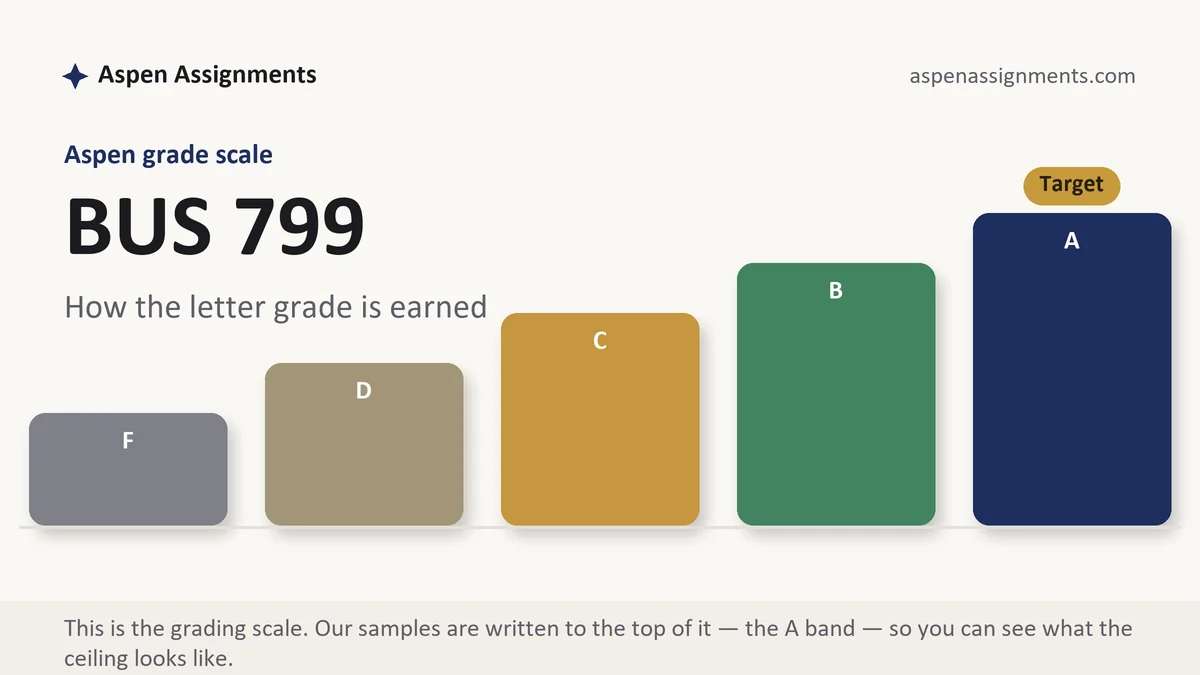
What BUS 799 is really about
At this level, BUS 799 is graded on application: the rubric wants you to take applied graduate business and use it on a real, specific situation, then defend your reasoning with current evidence. Recall alone does not clear the bar, which is why the work below rewards analysis over summary.
What BUS 799’s assessments ask for
Across most versions of the course, the graded work tends to include:
- a business plan or proposal.
- a SWOT or competitive analysis.
- case analyses of real companies.
- strategic or operational plans.
Where students lose points in BUS 799
The recurring rubric-killers on work like this:
- ignoring the financial or operational trade-offs the decision carries.
- a plan with no metrics to judge whether it worked.
- opinion where the rubric wants a named framework applied.
- recommendations with no real-company data behind them.
- staying theoretical instead of making a call and defending it.
The BUS 799 drawers
BUS 799 Module 1 assignment example
Capstone proposal: a composite commercial electrical contractor waiting 71 days to collect what it bills, $2.19 million of cash that a 50-day target would free, the scope a single capstone can carry, DMAIC as the method, and what the company gets at the end. Full sample paper, read it free.
BUS 799 Module 2 assignment example
Literature review: what research says about slow collections, from trade credit as unplanned lending to two large panel studies tying fewer receivable days to profit, why construction subcontractors wait longest, and what Six Sigma and change research warn about fixing it. Full sample paper, read it free.
BUS 799 Module 3 assignment example
Methodology: how the collections capstone will split 71 days into stages using 1,146 payment applications, code the causes of 80 late invoices with two independent coders and a kappa check, interview twelve people, and keep the results honest. Full sample paper, read it free.
BUS 799 Module 4 assignment example
Findings: the 71 days broken into six stages, 12 of them before an invoice even leaves the building, a Pareto of 80 late invoices led by missing lien waivers, coder agreement of 0.78, one general contractor at 84 days, and what project managers said about why billing waits. Full sample paper, read it free.
BUS 799 Module 5 assignment example
Discussion post: who can make or break the collections capstone at a composite electrical subcontractor, sorted by power, legitimacy and urgency, why project managers matter more than the owners who approved it, and three moves from Kotter's list to keep the billing cutoff from slipping. Full sample paper, read it free.
BUS 799 Module 6 assignment example
Recommendations: five changes that together target 21 days, from a day-five billing cutoff to closeout packages started at 75 percent complete, each with its expected days, owner and start date, early pilot results showing billing lag down from 11 days to 4, and the control plan that keeps the gains. Full sample paper, read it free.
BUS 799 Module 7 assignment example
Financial justification: what the collections plan costs, $18,000 once and $57,680 a year, against $175,000 a year of interest saved at 21 days and fewer written-off change orders, a three-year net present value of about $364,000, a low case that still pays, and the $2.19 million the balance sheet gets back. Full sample paper, read it free.
BUS 799 Module 8 assignment example
Final capstone presentation: twelve slides with speaker notes taking a composite contractor's owners from the 71-day problem to the decision, where the days go, what the pilot showed, what the plan costs and returns, and the three things the owners are asked to approve today. Full sample paper, read it free.
Your classroom shows something different?
Deliverable names and counts shift between course versions. Send what you see and the desk matches it exactly.
Using a BUS 799 sample the right way
Treat a BUS 799 sample as a worked example, not a shortcut. Seeing how a strong response is organized, how it hits each rubric row, and how it handles evidence is the fastest way to learn the pattern, then you write your own and submit that. Samples are built to the instructions you send, revisions included, and how you use one is on you: stay inside Aspen’s academic-integrity policy.
BUS 799 questions, answered
What kind of assignments does BUS 799 have?
BUS 799 typically runs to a business plan or proposal, a SWOT or competitive analysis, case analyses of real companies, and strategic or operational plans. The exact mix depends on your course version, so send your rubric and the sample is written to match it.
How fast can I get a BUS 799 sample, and what does it cost?
A custom BUS 799 sample written to your own instructions arrives in 24 to 48 hours, and your first one is free. Revisions are included.
Will the sample match my BUS 799 rubric?
Yes. It is written to the exact instructions and rubric you send, not pulled off a shelf. If your classroom shows different deliverables than the modules listed above, send what you see and the desk matches it.
Is it okay to use a BUS 799 sample?
Use it the way it is meant to be used: as a model for structure, sourcing, and how a strong answer is built, then write and submit your own work. Always follow Aspen's academic-integrity policy.