Send the exact assignment or rubric from your classroom and a custom sample written to it lands in 24 to 48 hours, the first one free. DNP870 is Aspen’s Health Policy, Advocacy, and Partnerships course. It centers on how health policy is made and changed, and how a doctoral practitioner builds the partnerships and evidence that move a proposal past committee. Searches like "dnp 870 module 4 assignment example", "DNP870 sample paper", and "DNP870 module samples" land on this page.
What DNP870 is really about
Eight modules, and the sequence in most sections walks a policy from idea to implementation. Early modules typically cover how bills become law in practice rather than in outline, including the committee stage where most proposals die, and the regulatory layer where agencies write the rules that decide what a law means. Middle modules usually take up analysis: framing a health problem so it reads as a policy problem, comparing options against criteria, and weighing who gains and who pays. Later modules often turn to advocacy and partnership, meaning coalitions, testimony, professional organizations, and the difference between a letter and a relationship. Discussions carry points and tend to be argumentative by design.
Policy writing has a form of its own, and it is not the essay form used in earlier courses. A brief is short, front-loaded, and written for a reader with four minutes and no clinical training. The recommendation appears near the top, the evidence supports it in ranked order, opposition is answered rather than ignored, and the ask is one sentence a person could act on. Samples on this shelf follow that shape. They open with a stated problem and its cost, name the level of government or the body with authority, compare two or three options honestly, and close with a specific ask, a named audience, and the coalition that would carry it.
What DNP870’s assessments ask for
Instructors here read for political realism. They want the correct level identified, since a state scope-of-practice fight and a federal reimbursement change are different arguments with different audiences. They want an actual bill, rule, or statute cited when the assignment calls for one, current enough to still be live. They want stakeholders mapped with their interests, including the ones opposed to you, and an honest account of why the opposition believes what it believes. They want the advocacy plan to name a target person or body, a channel, and a message, not general awareness raising. And they want the writing compressed, because a policy brief that runs like a term paper has already failed its reader.
Where students lose points in DNP870
Almost every weak policy paper in this course has the same hole: nobody pays for it. The proposal argues that screening should be expanded, or that a service should be covered, or that staffing should be regulated, and never says where the money comes from, which budget absorbs it, who bills whom, or what the offset is. Policy without a financing mechanism is a wish, and any reader with committee experience stops there. It is the fastest rejection in policy reading. Name the source: appropriation, reimbursement change, grant, fee, penalty, cost shift, or reallocation from an existing line. Then estimate scale, even roughly, and say who bears the cost when the money runs out.
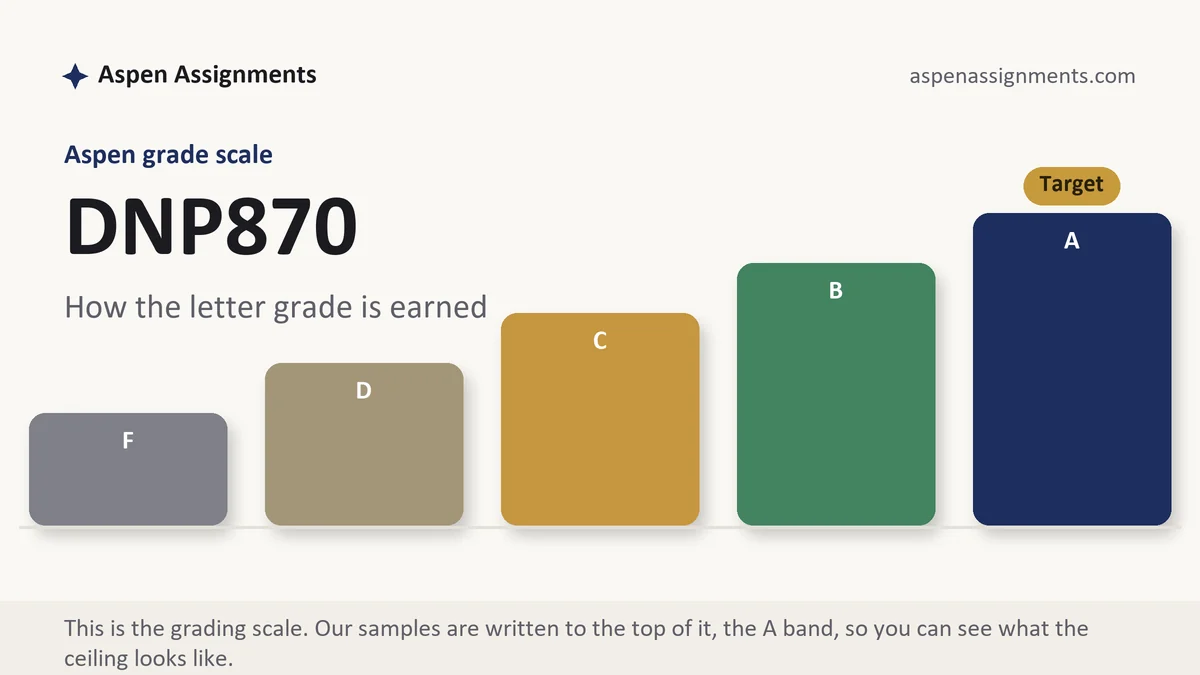
The DNP870 drawers
DNP870 Module 1 assignment example
Policy process paper: a state bill to pay for community health worker services under Medicaid, followed from drafting to a health committee hearing, a fiscal note, an appropriations detour and the governor's desk. Full sample paper, read it free.
DNP870 Module 2 assignment example
Regulation paper: the four paragraphs of a new community health worker statute and the dozens of decisions the Medicaid agency's rules must make before any worker is paid, with the comment period where nurses can still shape them. Full sample paper, read it free.
DNP870 Module 3 assignment example
Module 3 work often frames a clinical problem in terms a legislator recognizes. On request, free, 24-48h.
DNP870 Module 4 assignment example
Options analysis: a new Medicaid benefit for community health worker services versus a managed care contract requirement, judged against effectiveness, cost, equity and two kinds of feasibility, with the status quo as the baseline. Full sample paper, read it free.
DNP870 Module 5 assignment example
Stakeholder map: who supports, who opposes and who pays for the opposition to a community health worker coverage bill, traced through lobbying and campaign finance disclosures. Full sample paper, read it free.
DNP870 Module 6 assignment example
Discussion post: what my $300 state nurses association membership actually did for the community health worker bill, what it did not do, and why dues alone are not advocacy. Full sample paper, read it free.
DNP870 Module 7 assignment example
Testimony: written and oral testimony to a Senate finance committee asking for one thing, full funding of a $4 million community health worker pilot, with the evidence, one patient, and answers to the three objections members will raise. Full sample paper, read it free.
DNP870 Module 8 assignment example
Advocacy plan: taking a community health worker pilot statewide in the next session, with eleven named targets, the channel matched to each, a coalition budget that keeps lobbying and education money separate, and the measures of progress. Full sample paper, read it free.
Your classroom shows something else?
Aspen University revises courses; module counts and deliverables shift between terms. Send what your classroom shows and the desk matches it exactly.
Using a DNP870 sample the right way
Policy briefs are a form you learn by imitation, so read for structure before content. Notice how the first paragraph states the problem with a number attached, how the options section admits the weakness of the preferred choice, and how the financing paragraph sits where a reader expects it. Then rebuild that shape around the bill or rule your assignment names, in your state, with the stakeholders you can actually reach. Send the instructions and rubric from your classroom and the first custom sample comes back free, matched to the prompt, in 24-48h.
How these samples are written
Every sample in this log is written the way the custom ones are: the rubric decoded row by row, graduate courses held to the no-D graduate ladder's reality, formats exact. Aspen revises classrooms; a custom request is always written to the rubric in YOUR course, never from a stale template.
DNP870 questions, answered
How much financial detail does a policy brief need?
Enough to answer three questions: what it costs at a stated scale, where the money comes from, and what it displaces. You are not building a budget, so a cited estimate and a named funding source usually satisfy the criteria. What fails is silence. A recommendation with no payer attached reads as unserious no matter how strong the clinical evidence is.
My policy is about a practice change, not a spending program. Does financing still apply?
Yes, because someone still absorbs the cost. Extra screening consumes visit time, a documentation requirement consumes staff hours, and a new standard consumes training days. Say which budget or which role carries that burden and whether reimbursement follows. Papers that treat unfunded requirements as free are the ones that come back with questions about feasibility.
How do I handle opposition without weakening my own recommendation?
Answer it on its terms, which in health policy usually means money. State the strongest opposing argument, concede what is true in it, then show your financing mechanism absorbing the objection: who funds it, over what period, and what the offset is. A brief that ignores the cost objection loses more credibility than one that admits a real limitation.